
10-Minute Read
If you’re a small business owner scouring the internet for tax advice, you may have come across something like this: “Once your LLC makes $50,000, elect S-Corp status and instantly save 15.3% on payroll taxes!”
The problem is that such advice treats business entity selection as a simple binary switch rather than a multi-variable feedback loop. As a former engineer, I often see things as the latter (for better or worse).
This is a somewhat technical piece aimed at business owners and financial advisors. However, it can also be helpful if you’re considering starting a small business. The information below becomes particularly practical when you own a profitable small business.
I’ll present a framework I personally found useful when deciding to make the S Corp election for my own financial planning practice. While I’ve long been aware of the general rules, what really hit home during a deeper dive is that optimizing in one corner of the tax code can create leaks elsewhere. What the right balance is for me may not be right for you.
The considerations I’ll lay out apply primarily to business owners whose entities are structured as an LLC, partnership, or sole proprietorship. There are also (rare) situations in which C Corporations switch to S Corporations. Business entity selection involves many other considerations, particularly from legal, estate, and exit-planning perspectives.
In this piece, we’ll explore the pros and cons of making the “S Corp election” for your small business from a tax planning perspective only. We’ll cover the basic math and four friction factors you should consider before making this leap. Let’s jump in!
Background and the (Flawed?) Baseline Math
Small businesses exist for many purposes, but a fundamental reason is to make a profit. If successful, the next step is figuring out how much of that profit you can keep. This almost inevitably leads to the question of whether you should elect to be taxed as an S Corporation.
Let’s start with the primary benefit of making the S Corp election: allowing the business owner to control wages paid so that “profits” are not subject to payroll taxes.
There are a few things to unpack with that comment. First, what are payroll taxes? Also known as the FICA tax, it is comprised of two parts:
- 12.4% Social Security – capped at wage base ($184,500 for 2026)
- 2.9% Medicare – all eligible income
- Combined Rate of 15.3%
This total rate of 15.3% is shared responsibility between the employer and employee. If you’re self-employed, you pay the full 15.3% rate for yourself and your employees. If your only role is as an employee, you pay half the rate, or 7.65%.
Note: For sole proprietors, the effective self-employment tax rate is slightly lower (~14.1%) due to the employer-half deduction on Form 1040, but the 15.3% nominal rate serves as our baseline.
The “standard” S Corp hack is to shift income from self-employment (subject to 15.3% FICA) to S-Corp distributions (exempt from FICA). Put another way, the tax code is designed so that genuine profits are not subject to payroll taxes.
The baseline savings – Barring some constraints in the IRS code- $100,000 shifted from self-employment profit to an S-Corp distribution saves $15,300 in FICA tax annually.
Sidebar: While we won’t go into the technical details in this piece, there’s also something called a Qualified Business Income Deduction (QBID) that helps reduce your federal tax obligations as you shift profits towards distributions instead of salary.
So, when I phrase everything like this, it will seem like you should just make the S Corp election and take all your business profits as distributions. But there are some hidden costs, or at least what we’ll call friction factors, to consider:
- #1 – IRS Defensibility
- #2 – Eroding Future Social Security Benefits
- #3 – Maximizing Retirement Plan Contributions
- #4 – Other Cash Leaks & Admin Items
Factor #1 – IRS Defensibility – Reasonable Comp
The first catch behind the massive potential tax savings of an S Corp is that you must pay reasonable compensation. This is defined as the amount that would ordinarily be paid for “like” services by “like” organizations in “like” circumstances. Yeah, so there’s a decent amount of gray area here.
There are two primary approaches allowed for determining reasonable compensation.
- Market Approach – This method, also called the “industry comparison,” involves comparing your role—such as CEO or general manager—as an owner to non-owner executives in similar companies within the same industry and location. Typically, this results in a higher wage. Although the IRS is more inclined to accept this approach, it usually offers fewer advantages for tax savings.
- Cost Approach – Here, you divide your hours among specific job tasks and assign market wage rates to each task. This typically lowers the overall wage because small business owners often perform some “low-value” administrative tasks. For instance, admin work might be valued at $25/hr., while higher-level executive tasks could be valued at $60/hr. Employing the cost approach reduces the overall weighted average of your salary.
Both approaches outlined above can require effort and proper documentation. You might need to spend time researching BLS data and industry benchmarks. Although some companies can assist with these calculations, doing so will incur extra costs.
Complex measures may not be strictly necessary, though. The prominent tax court cases I’ve seen start with situations where the owner-employee is not receiving any wages at all! Clearly that’s going to draw the attention of the IRS.
Tip: If you have a profitable S Corp, pay at least “some” salary. Otherwise, you’re unnecessarily drawing the attention of the IRS.
Alternatively, paying a “small” wage like $20,000 when profit distributions are many multiples of that is likely a high-risk strategy regardless of the industry you’re in. The IRS could argue that an “independent investor” would compensate its principal leader more generously if the business is generating substantial profits.
Here are a few more tips as you think about establishing a reasonable comp:
- Track your hours and duties – If any of these change substantially over time, your compensation in wages may need to change (up or down)
- Count Fringe Benefits – While our goal is often to get to the lowest allowed wage, keep in mind that things like health insurance and health savings account contributions paid by the company are added back to the wages that flow through to your tax return, while generally being exempt from FICA taxes. With health insurance costs where they are today, this can make the S Corp math highly favorable.
- Take Annual COLA adjustments – If you keep a round salary figure like $70,000 and never change it for many years, while your business net income grows substantially, that could be a red flag. Applying a COLA increase based on regional inflation metrics is good practice.
- Be careful using formulas – I say this as a reminder to myself because I love formulas. I admit I have a strong desire to set a reasonable comp based on some percentage of business revenue or profits. While that may work under some conditions, there’s no legal standard behind it. An approach based on market data or multiple variables is more likely to withstand an audit. Furthermore, if you’re in a business with highly fluctuating revenues or profits, you’ll end up with volatile wages. That’s likely to result in drastically underpaying or overpaying FICA taxes.
- View it as an outsider – Imagine a role reversal. Would you personally consider working at a different business earning the wage you’re trying to pay yourself as an owner? If the answer is emphatically “No”, there’s a good chance you’re using too low a wage!
All these points are meant to put you in the best possible position in an audit. If during an exam, the IRS adjusts your wages (a.k.a. shareholder compensation) upward, a few things can happen:
- They may assess additional employment tax
- They may reduce your QBI deduction (briefly alluded to earlier, but losing this deduction increases your federal taxes)
- You may owe interest and penalties
Put another way, take your reasonable comp decision seriously. Otherwise, the IRS can take multiple bites out of the same “apple”.
Factor #2 – The Social Security Bend Point Opportunity Cost
So now we know you need to pay “reasonable” wages, if only to stay compliant with the IRS. But there’s a second reason: Your salary is an investment, not just an expense. What you pay as wages impacts your future Social Security benefits.
Technical tip: Lowering your W-2 salary to save 15.3% today explicitly lowers your Average Indexed Monthly Earnings (AIME) for Social Security (SS). You have these so-called “bend points” that impact your future benefit payout. But as the chart below shows, not every dollar you pay in wages is treated equally.
The Staircase of Diminishing Returns
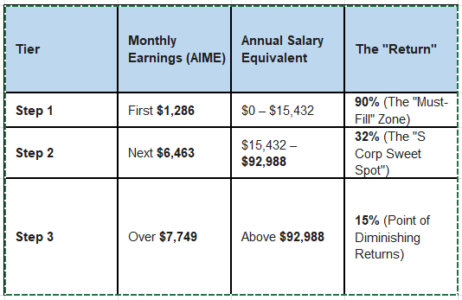
Reasonable comp considerations aside, most business owners should at least pay themselves enough wages to fill up the “must fill” zone where there’s a 90% replacement rate in future SS income. Unless unusual circumstances apply, you must always maximize this baseline.
But since that “must fill” zone is a low threshold, the next-level optimization is the 32% replacement rate, which I’m calling the “S Corp Sweet Spot”. You’ll notice that the second bend point ends at $92,988 annually ($7,749/month). Every dollar of wages up to this threshold generates a 32% inflation-adjusted lifetime replacement rate in your future SS.
Essentially, paying 15.3% in FICA to secure a 32% inflation-adjusted lifetime replacement floor is mathematically one of the best “investments” an owner can make.
Finally, if you pay enough wages to put you into the 15% replacement rate range, it still helps increase your future SS benefits, but you don’t get nearly the same “return on investment” from your FICA taxes paid.
While we won’t go through the full math in this piece, here are some other key variables that impact your future Social Security. You might refer to some of our past blogs that explore:
- How Much Can You Rely on Future Social Security Benefits?
- Your Social Security Statement May Not Tell the Full Story
- The Top Four Questions I’m Asked About Social Security
Factor #3 – Maximizing Retirement Plan Contributions
We’ve talked about some reasons not to be overly aggressive with minimizing wages paid (to get payroll tax-free distributions). One is navigating IRS reasonable comp guidelines. Another is to optimize your future Social Security benefits. There’s one more item I’ll point out here.
If maximizing your retirement plan contributions is a goal, understanding how the “Solo 401(k) throttle” operates is important. Although there are other small business retirement plans, the Solo 401(k) is especially popular for businesses without eligible non-spouse employees, so I will focus on it as our example.
For an S Corp (or LLC taxed as an S Corp), your allowed Solo 401(k) contributions are based on W-2 salary choices you make.
First, there’s the “employee” contribution side. Here are the contribution limits for 2026:
- Standard Contribution limit (under age 50): $24,500
- Plus, potentially:
- Standard Catch-up (Age 50+): $8,000
- OR Special Catch-up (Age 60 to 63 only): $11,250
Next, there’s the “employer” profit-sharing contribution. This can be as high as $47,500 (for 2026). But the key thing is that it is limited to 25% of the W-2 wages paid.
So, let’s put this together in two brief examples.
Example #1
If you’re a business owner under age 50 and you want to contribute $50,000 into your own Solo 401(k). You’ll need to pay yourself a wage of at least $102,000. This allows you to do the following:
- Contribute $24,500 as an employee contribution.
- Contribute $25,500 as an employer profit-sharing contribution ($102,000 * 25%).
- Total 401(k) Contribution: $50,000
Example #2
If you’re the same business owner as Example #1, but you want to get aggressive with distributions and only pay yourself a $20,000 wage, you might be limited to around a $23,000 Solo 401(k) contribution. Determined as follows:
- Contribute $18,000 as an employee contribution (not $20,000, as there must be some room for FICA withholding)
- Contribute $5,000 as an employer profit-sharing contribution ($20,000 * 25%)
- Total 401(k) Contribution: $23,000
In most cases, unless wages are too low, your choice of W-2 salary won’t impact your “employee” side retirement contribution. But watch out for how it can choke your employer contribution! Finally, note that these 401(k) contributions can be made in either a pre-tax or Roth manner. This adds an interesting layer to your tax planning.
Factor #4 – Other Cash Leaks & Admin Items
As we wrap this up, let me end by listing a few other things you want to have on your radar as you consider an S Corp. Essentially, the tax savings can’t just be viewed in a vacuum.
- Overhead Costs and Time – Expect tax preparation costs (or your time spent) to increase because you’ll have a separate business tax return (Form 1120-S) with a K-1 that flows into your personal tax return. You’ll have to keep track of something called “basis” for the business. Furthermore, if you never ran an official payroll, you’ll have to start doing so. This will involve payroll software costs (e.g., Gusto/ADP). These also introduce new processes, tracking, and timing constraints for your business.
- FUTA & SUTA – These represent federal and state unemployment taxes. The federal (FUTA) is a fixed expense, but the state tax (SUTA) varies depending on your location. For example, Texas has a low “wage base,” while states like Washington have a higher SUTA tax per employee.
- Accountable Plan – If you were previously taking a home office deduction as a sole proprietor, you don’t lose those tax benefits as an S Corp. But you must account for it differently. An accountable plan is an IRS-approved policy that lets an S Corp reimburse owner-employees for business expenses paid out of pocket. The nice thing is these reimbursements are deductible for the business and tax-free to you…avoiding both federal and payroll taxes.
- The 5-Year Lockout: When you make the S Corp election, you want to do so with the intention of it being a long-term decision. It’s not so easy to flip back to LLC taxation next year if profits drop. While some exceptions may apply, if S Corp status is terminated, it must generally wait five taxable years before it can re-elect S Corp status.
Conclusion – Finding Your Equilibrium
If you followed the logic of this blog (and congrats if you have), I’m hinting at a concept you might call the S-Corp Equilibrium—the mathematical point where current FICA savings, future Social Security income, retirement wealth accumulation, and administrative frictions balance out favorably.
The challenge is I’m not aware of any “back-of-the-napkin” math you can use to find your equilibrium. All I’ve done in this blog is lay out most of the key tax variables. But if you really want to do it right, it’s going to take some dynamic scenario modeling.
That said, here’s a baseline tax savings example that pulls together many of the key variables discussed in this blog.
S Corp vs. Sole Prop – Tax Savings Example
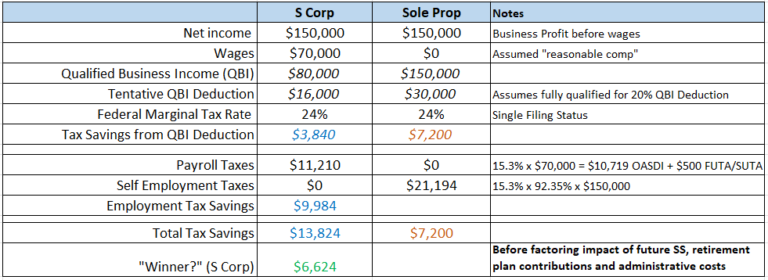
These numbers are hypothetical to illustrate potential benefits. For my own business, the advantages outweighed the friction factors when I modeled everything. However, my own balance might shift over time, as business performance and tax laws are constantly changing.
The bottom line: Under the right circumstances, the tax savings from operating an S Corporation can be meaningful and enhance your long-term wealth strategy. You just need to find the right balance for you.
If you have comments or questions on this piece, please drop me a line at: [email protected]
References
- https://www.irs.gov/businesses/small-businesses-self-employed/s-corporations
- https://www.bls.gov/bls/blswage.htm